




The risk of flying blind without monitoring
At large airports, thousands of take-offs, landings and taxiing movements are handled every day. In a company's IT environment, countless data streams, server processes and applications run in parallel during the same time. This volume carries a high risk: a single unnoticed error can spread unhindered and cause major damage. If the air traffic controller loses attention for a moment, warning signals go undetected. Examples include a server slowly approaching its capacity limit, a faulty application silently dropping requests or unusual data traffic indicating a threat. Without constant observation, there is no proactive response, only cleaning up afterwards.
What does IT monitoring detect?
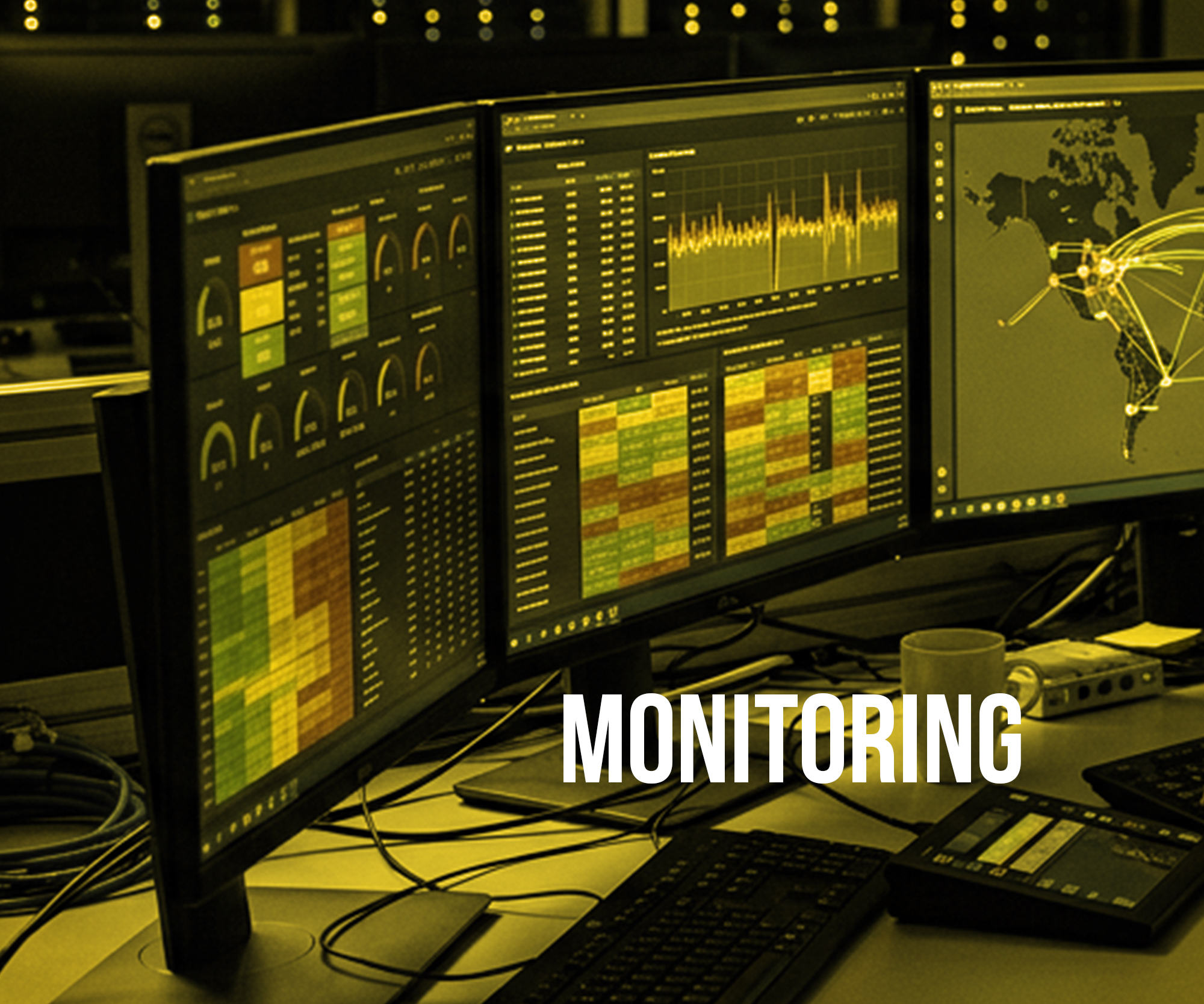
How exactly does the air traffic controller operate in the background of a company? Monitoring collects data and metrics from the entire infrastructure without gaps, consolidates them into an overall picture in real time and evaluates it continuously. This way, for example, unusually high CPU loads on servers, dwindling storage space or suddenly increasing response times of applications are detected, and this at the very moment they occur.
For companies, this means a decisive change of perspective: instead of only learning about an outage when an angry customer calls, administrators already see the critical deviation on their "radar screen" before it becomes a problem. A manufacturing company detects early on that the control software of a production plant is no longer connecting to the central system and can intervene before the line comes to a standstill. A SaaS provider notices that the response times of its application are continuously rising during the morning usage peak and scales up the servers before customers experience timeouts or get logged out.
Which areas does IT monitoring keep an eye on?
The real question is: which areas does it not keep an eye on? During their shift, an air traffic controller does not lose sight of a single point in their sector. Every change in altitude, every speed, every deviation from course is registered. This is exactly the standard a company should set for its monitoring. It is about a complete view of every interface, every application and every process relevant to operations.
This process starts at the infrastructure level and extends from there into the deepest branches of the IT landscape. From the backup server that is supposed to save the data in an emergency to the client that accesses it every day. From the control software that has to make the right settings to the individual production machine that implements them correctly. Databases, cloud resources and hybrid environments in which many companies work today are also part of this.
What matters here is not only the breadth of this monitoring but also its depth: every single step along the path of data and processes must function smoothly and deliver the usual performance, just as every single phase of a flight, from take-off to landing, must proceed safely and without disruption.
Why every company needs IT monitoring
IT monitoring is particularly relevant for companies with complex IT infrastructures as well as for businesses whose operations depend on critical applications and contractually guaranteed SLAs. Here, an outage is like a collision in airspace: just a few minutes of downtime can result in severe contractual penalties, claims for damages or lasting reputational damage. These are consequences that are reflected both in the balance sheet and in customer trust.
But the need for a vigilant air traffic controller is no longer limited to large companies with particularly complex systems. In recent years, monitoring has evolved from a "nice to have" into an operational necessity for companies of every size. This is due to several developments that are making IT landscapes increasingly difficult to oversee: the migration of applications to the cloud and hybrid infrastructures, the use of microservices and containers instead of individual, clearly delineated systems and strongly fluctuating workloads, for example due to seasonal demand peaks or growing user numbers. Where a few central servers used to be manageable, operations today are spread across a network of services, interfaces and dependencies that simply can no longer be controlled safely without continuous monitoring.
Conclusion
IT monitoring is therefore far more than a mere overview of the company. It is the "tower" that keeps constant watch in the background without being in the spotlight itself. Monitoring enables the early detection of potential difficulties and thus proactive action. Because whether service provider, wholesaler or manufacturer: in the end, what matters is not only your own performance but also whether the IT in the background is running smoothly. Only a reliable air traffic controller ensures that every process takes off safely, stays on course and ultimately lands where it was supposed to. All without incidents, without delays and without anyone even noticing.
Our tip: DTS Monitoring Services
With the DTS Monitoring Service, a company gets the right air traffic controller at its side, of course "Made in Germany". Proactive error detection, fast problem resolution and a transparent system overview deliver maximum availability and optimised performance. Various operating models guarantee a solution tailored to the needs of every company, whether self-hosted & managed or, to save resources, hosted and managed by DTS experts. All for higher availability and a sustainably stronger IT, OT and IoT operation.